Discover more about coral reefs and oceans:
Magic Porthole will have substantial background information about coral reefs as well as links to other sources such as information provided by NOAA's National Ocean Service
where you can find:
What are Corals?
Where Are Coral Reefs Found?
Zooxanthellae…What's That?
How Do Coral Reefs Form?
How Do Stony Corals Grow?
How Do Corals Reproduce?
Importance of Coral Reefs,
Natural Threats to Coral Reefs,
Anthropogenic Threats to Corals,
Coral Diseases
Protecting Coral Reefs
NOS Education Discovery Kits References
YouTube Video Playlist is a collection of videos posted on the NOAA, Ocean Explorer YouTube channel courtesy of our various expedition science teams from 2001 - 2008.
CReefs is one of 17 projects of the Census of Marine Life
An international cooperative effort to increase tropical taxonomic expertise, conduct a taxonomically diversified global census of coral reef ecosystems, and improve access to and unify coral reef ecosystem information scattered throughout the globe.
See Census of Marine Life special feature
Magic Porthole invites you to write to us about your efforts, to become youth advisors, and to participate in the Horizon Solutions Site coverage with your articles and photographs.
Locate and Find out the conditions of your favorite coral reefs:
These sources can help you locate coral reefs with satellite imagery, check weather conditions, and get news about ecosystems in which your favorite reefs creatures live, and find ideas for what you can do to help coral reefs such as helping to reduce Global Climate Change.
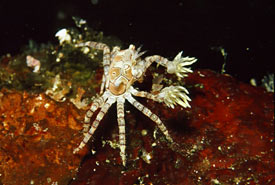
For example, go to Mauritius where Boxing Barry’s real life boxing crabs live.
Download for free: Google Earth
http://earth.google.com/download-earth.html
Check the weather conditions
See Ocean Surface Topography from Space, from NASA Jet Propulsion Laboratory: http://sealevel.jpl.nasa.gov
Caribbean Coral Reef Ecosystem Monitoring with a reef fish database
NOAA's Coral Reef Information System (CoRIS) is designed to be a single point of access to NOAA coral reef information and data products, especially those derived from NOAA's Coral Reef Conservation Program.
Find ideas for what you can do to help coral reefs from these and other sources:
Coral Reef Conservation
Help reduce Global Climate Change:
Making Global Warming Solutions Locally Relevant and Accessible
Alaska’s new state specific Website provides a calculator and comprehensive, heavily linked local solutions section with solutions that can be applied throughout the United States
Consumer awareness:
Check regularly to see which fish you and your family and schools should avoid by visiting Web sites that provide updated information.
Your choice of fish to avoid because they are endangered or whose loss will endanger coral reef ecosystems can be found on many Web sites.
These lists and other provide names of fish available to consumers which are most vulnerable to over-fishing and/or are fished using methods which cause damage to the environment or non-target species. For example, Monterey Bay Aquarium Seafood Watch is a program “…designed to raise consumer awareness about the importance of buying seafood from sustainable sources. We recommend which seafood to buy or avoid, helping consumers to become advocates for environmentally friendly seafood.”
Fish to Avoid Eating:
Check regularly to see which fish you and your family and schools should avoid because they are endangered or whose loss will endanger coral reef ecosystems by visiting Web sites that provide updated information.
Among the sites that provide names of fish available to consumers which are most vulnerable to over-fishing and/or are fished using methods which cause damage to the environment or non-target species include: Oceans Alive and Fish Online
Fish to avoid collecting for aquariums are provided by many sites including: Aquatics Unlimited
www.solutions-site.org
www.solutions-site.org/kids
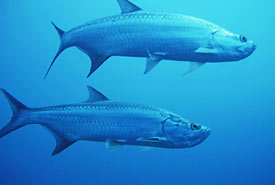 |
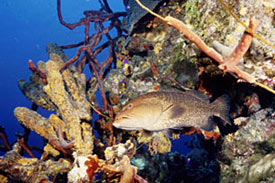 |
|
At night some hunters from the open ocean like these Tarpon come to the reef to try their luck. (Saba, Caribbean)
|
Groupers are the main large residential predators on the reef. They change sex as they grow older. Many, like this Tiger Grouper live in caves from where they survey their territory. (Bonaire, Caribbean)
|
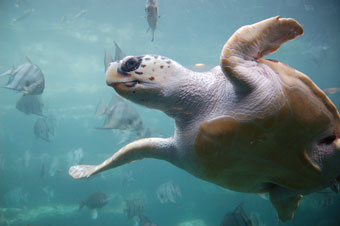
Underside of a loggerhead sea turtle as it swims overhead. This photo was taken on August 10, 2006. Photograph courtesy of Upendra Kanda (from Flickr and Wikipedia).
Sea Turtles
"Turtle Positioning System" helps reptiles on fantastic voyage
"There's no off-the-shelf Speedo turtle bathing suit that we know about," laughed biologist Ken Lohmann, as he attached a soft cloth harness, or bathing suit, to a three-month-old loggerhead turtle.
About a dozen of these young turtles "work" in Lohmann's University of North Carolina (UNC) laboratory. With help from the National Science Foundation (NSF), he's learning how these and other sea turtles use the Earth's magnetic field for a journey of thousands of miles around the Atlantic Ocean.
Loggerheads have no interaction with their parents. Females bury eggs on the beach that hatch 50-60 days later. But the hatchlings seem to be programmed with an astonishing "Survival To Do List."
Item One: Get out of Dodge.
"The hatchling turtles start life with a supply of yolk attached to their bellies," said Lohmann. "And during the first several days of their lives, they don't stop to eat. All they do is migrate offshore. Their entire survival strategy seems to be predicated on the idea that the faster you get away from land, the better," he said.
In these first few frenzied days, the yolk sac provides nutrition, and the hatchlings guide themselves offshore by instinctively swimming into waves. This gets them away from shallow waters and numerous predators.
Item Two: Follow the Magnetic Field
"We've found over the years that one of the turtles' main tricks for navigation is that they are exquisitely sensitive to the Earth's magnetic field," said Lohmann.
Knowing when and where to turn is critical in the five-to-10-year journey that takes them from the east coast of the United States to the coast of Portugal, south toward the west coast of Africa, then back toward the beach where they were born.
For example, there's a magnetic field off Portugal that triggers the turtles to turn south. If they don't, they'll likely be swept into frigid waters off Great Britain and Scandinavia, and die.
"In one experiment, we exposed young turtles that had never before been in the ocean to magnetic fields that exist at three widely separated locations along their migratory route," said Lohmann.
The large majority of the South Florida-hatched turtles in that experiment--whether exposed to the fields they would encounter off Florida, Portugal or Africa--swam in the proper direction to complete their circular route around the Atlantic.
"We were astonished! It really was a very surprising and exciting finding," said Lohmann.
"The results implied that the turtles can actually distinguish among the magnetic fields that exist in different geographic locations and, what's more, they seem to use these fields as a system of navigational markers that help them complete their migration," he said.
Lohmann said the turtles go beyond using the magnetic field as a compass. They also use it as a source of positional and geographic information.
"In effect, sea turtles have a crude global positioning system that is based on the Earth's magnetic field," said Lohmann.
A better understanding of this turtle ability could help in research of both animal and human navigation. Some other animals, from salmon to spiny lobsters to migratory salamanders, might also use the Earth's magnetic field in similar ways.
Another experiment in the Lohmann lab tests how the turtles respond to wave motion. Looking at these turtle "athletes" is rather odd. Outfitted in their "bathing suits" and suspended on a mechanical wave simulator that moves them in circles, the turtles "swim" - without any water! (See photo, top right)
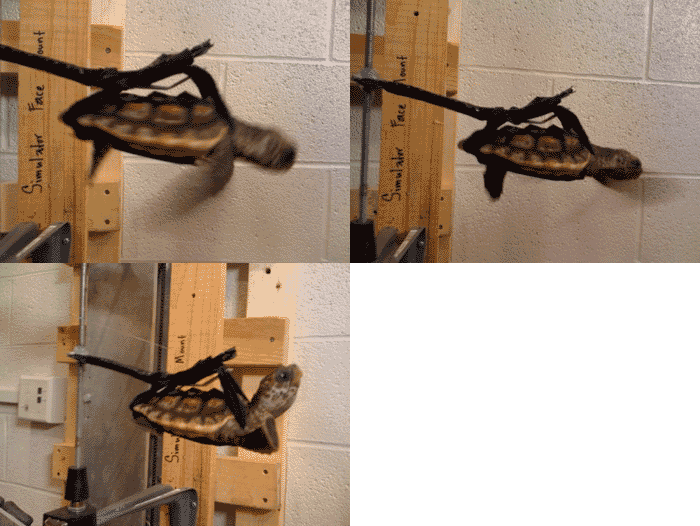
A three-month-old loggerhead turtle "air swims" while attached to a wave simulator at the University of North Carolina at Chapel Hill. Environmental cues alert hatchling turtles to swim into ocean waves to distance themselves from shallow water predators. Check out these animations to learn more about wave formations.
Credit: Marsha Walton, Science Nation
"The turtles will actually act out their swimming behavior in air," said Lohmann. "When a turtle first enters the ocean, the signal that tells it to begin swimming is the absence of any contact with the substrate. Young turtles are positively buoyant, so they float up when they enter the water, and as soon as nothing is touching the underside of a turtle, it begins to swim."
"In shallow coastal areas, waves reliably approach the land from the deep water, so swimming into waves reliably guides turtles offshore," said Lohmann.
As hatchlings, the turtles in the UNC-Chapel Hill lab are tested for about 15 minutes on the "wave simulator" in a typical experiment. Older turtles might spend an hour to an hour and a half swimming (or "air swimming") for this navigation research.
It's a pretty good gig. None of the turtles in this lab would have survived without human intervention.
Of about 100 baby turtles that hatch out of eggs in a typical sea turtle nest, some are too weak to crawl to the surface of the sand. The turtles in this UNC study were all rescued from nests on North Carolina beaches. Once rehabilitated and healthy, they will work in Lohmann's lab for a couple of years and then be released into the Atlantic.
Lohmann's study of animals and magnetism began when he was studying neurobiology, working with sea slugs as a graduate student. Two decades later, he is still helping to unlock answers.
The dramatic connection between turtles and magnetic fields is already altering conservation efforts for these reptiles.
"When we think about preserving habitats for animals, we normally gravitate toward traditional descriptions of the environment: What sorts of plants are there, what the humidity is, what sort of climate exists. But when you learn more about particular species, you discover that the list of criteria for what constitutes an environment may be somewhat different. In the case of the turtles, it has become evident that the magnetic field has to be taken into consideration," said Lohmann.
There's already been a change in procedure for some sea turtle rescue groups who monitor turtle nests. Historically, these scientists and volunteers would put wire mesh screens over the nests to keep predators like raccoons from eating the eggs. But now that it is known that these metal coverings could alter the developing turtle's magnetic "imprint," the conservation practice has changed. South Carolina, for instance, has replaced metal protective cages with plastic ones.
Loggerheads, leatherbacks and other sea turtles are threatened in many parts of the world. As someone who has cared for lizards, snakes, frogs, toads and turtles since he was a kid, Lohmann believes his work will be part of the solution.
"The people who are involved in our research usually are passionate about both science and conservation. They enjoy the challenge of trying to figure out things that are very difficult to learn about. At the same time, they are deeply devoted to the welfare of animals. We really like sea turtles and want to see them prosper in the future. Part of the fun for us is using our scientific expertise to do research that promotes sea turtle conservation," said Lohmann.
Miles O'Brien, Science Nation Correspondent
Marsha Walton, Science Nation Producer
This article and video are courtesy of Science Nation.
About Science Nation: Science is never out of style--and there's never a "final frontier."
In the National Science Foundation's Science Nation online magazine, we examine the breakthroughs, and the possibilities for new discoveries about our planet, our universe and ourselves: An artificial retina that can help the blind to see; new materials to build things bigger, better, lighter, and stronger; new ways to make our lives better without making the environment worse; and what we can learn from organisms that can live and thrive in frozen deserts or steaming-hot volcanic vents. Each week, Science Nation takes a dynamic, entertaining look at the research--and the researchers--that will change our lives.
|